Akin Shonibare
Software engineer in Toronto and New York. I build infrastructure at Shopify and make apps at Coraki.
Shopify
Six years building platforms other engineers rely on.
Three teams.
2025
Platform Infrastructure, Job Platform
The datastore under every background job, moved from one system to a replicated cross-region one. I built the failover and failback path and drove the first live cross-region transfer; designed and built the configuration service that keeps clusters correct across restarts; built the guards against split-brain and unsafe evictions on Kubernetes; led root-cause analyses and shipped safer incident controls; made every job test run against both datastores in CI. The shape of it: change the ground under a system while it is running.
2022
Oxygen and Custom Storefronts
Hosting for React storefronts at the edge. I championed the re-architecture into decoupled, event-driven services and a staged rollout that moved every merchant without a regression; co-built a system that replays production traffic against every pull request; led trace exports into merchants' own observability tools; merged two Cloudflare zones into one. The shape of it: make a hosting platform safe to change.
2020
Online Store and Themes
Git-based workflows for themes, and the first version of the GitHub integration that let merchants' developers treat a theme like code. The year I learned how a platform with millions of tenants rolls anything out.
Engineering
The through line.
Every team was a platform, which means the users were other engineers and the failure modes were theirs before they were mine. The work that mattered most was never the feature. It was the rollout plan, the test that ran against production traffic, the failover path that had been exercised before it was needed, and the write-up afterwards.
Languages and tools along the way: Ruby, Go, TypeScript, Python and Lua; Kubernetes, Terraform, Cloudflare Workers; Tarantool, Redis, MySQL, Kafka; OpenTelemetry and the usual on-call.
Alongside Shopify
Coraki.
Since 2023, a studio with Cory Crowley: applied AI, engineered to last, for funded startups and enterprises. memo and Ravine are made there. The Coraki section has the rest.
memo
A personal notebook for text and voice. Search past notes or ask a question and see which notes the answer came from.
Screenshotswhat it is
One primitive, many views.
Everything goes into one table of captures: text, a voice note, later a photo. Nothing is categorised at capture time. A worker transcribes it, extracts todos, events, people and ideas, and embeds the text. Every feature since has been a new kind of extraction and a new query over the same store, never a new module.
It is a personal app built to the decision standard of a product with real users: a multi-tenant schema from the first migration, idempotent jobs with visible failure states, tests against a real Postgres, and evals that fail the build when extraction quality drops.
Screenshots
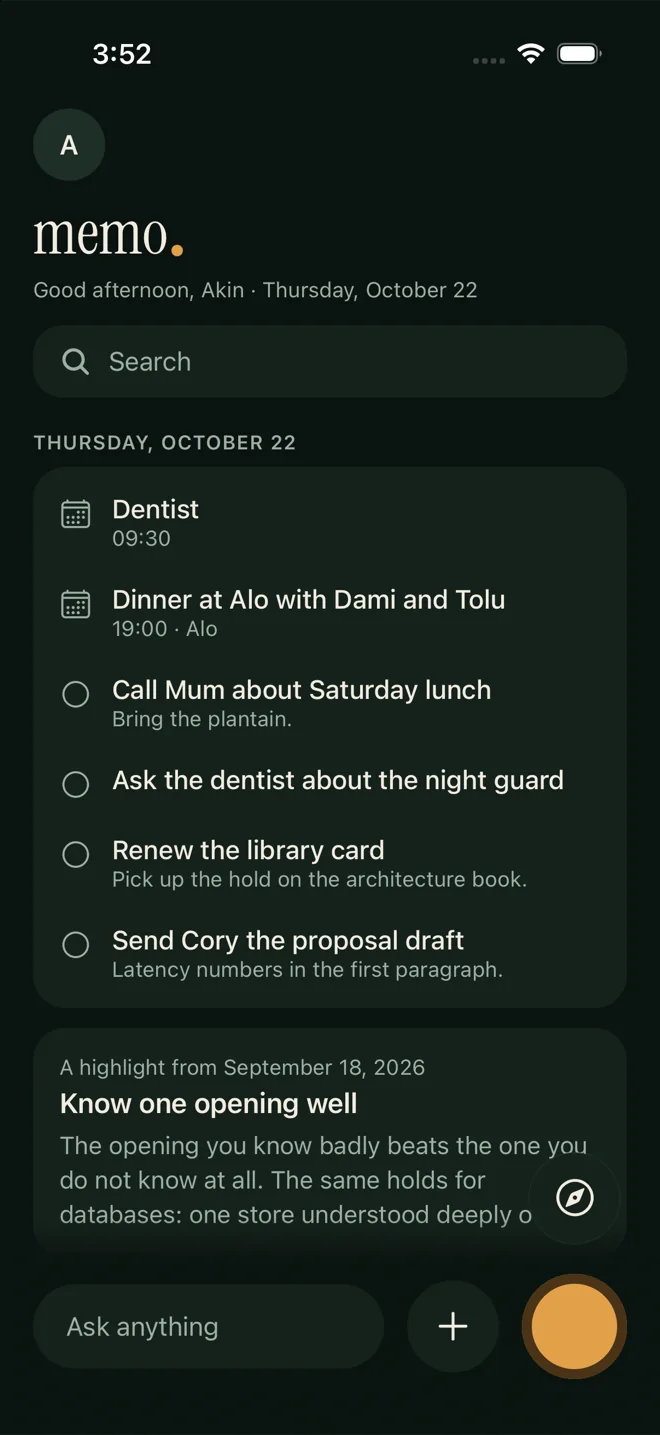
TodayWhat is on, and one old idea back. 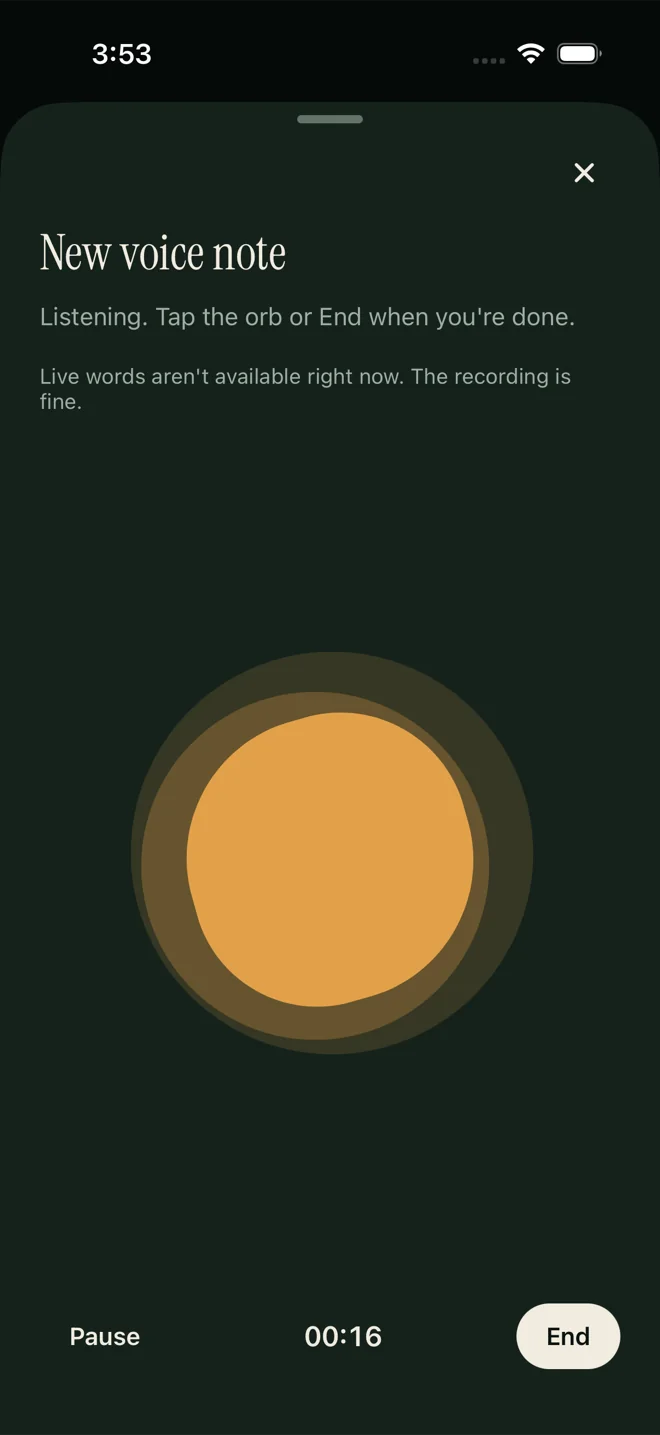
RecordThe recording screen while memo listens to a voice note. 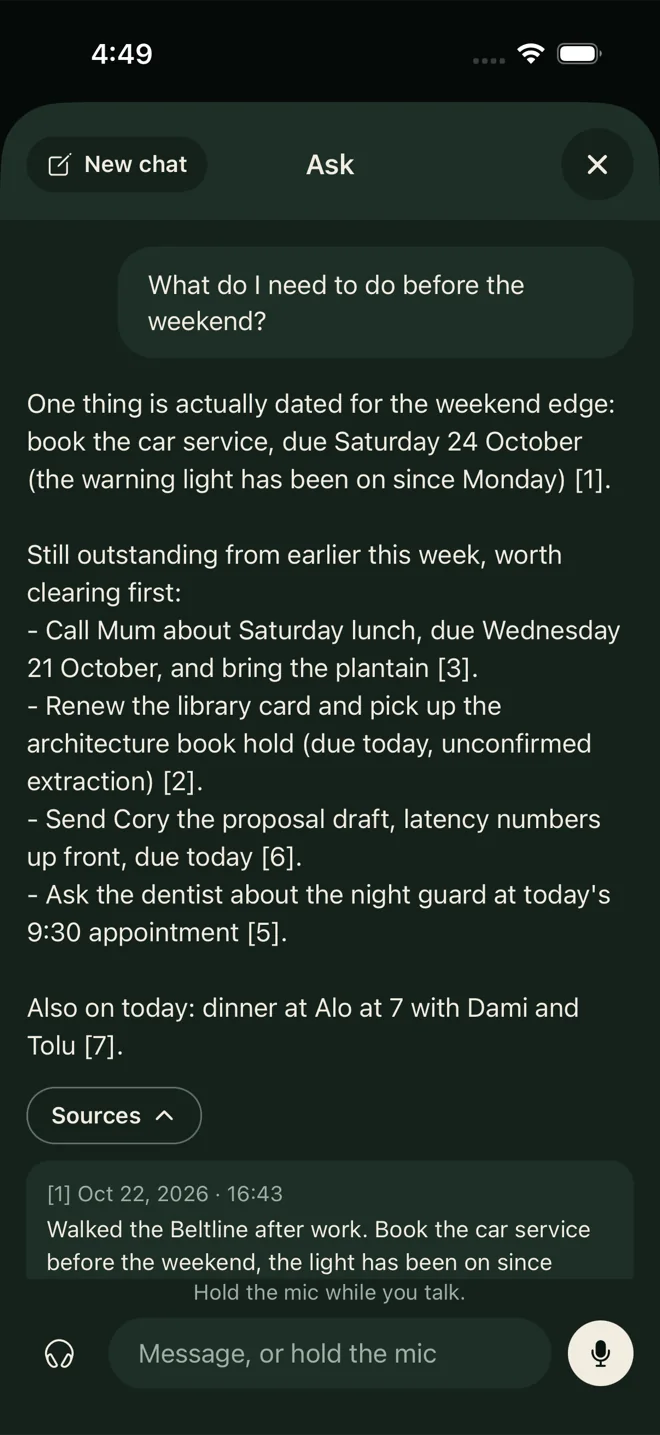
AskEvery answer cites the note it came from.
captures
Everything in, timestamped. One write path.
derivations
Typed extractions pointing back at a capture: todo, event, idea, person, habit, list item.
chunks
Embedded text for retrieval. Vector plus full text, fused by reciprocal rank.
how a note travels
The line.
The request returns an id at once. Everything after that is a background job with retries and a dead-letter state you can see.
- captureText or audio lands. The request returns an id at once; everything after is a job.
- transcribeHosted speech to text, with the people in your notes sent as keyterms.
- extractOne Pydantic schema constrains the model and validates the result. One repair, then terminal.
- embedShort notes are one chunk; long ones split on structure. Items are embedded on their own, with their dates.
- readyAsk can see it. The morning view will bring it back.
how an answer is made
Search, then the model.
Retrieval-augmented generation is two systems. The database decides which notes are relevant and what is true about them. The model only writes.
- rewriteOnly when the question leans on earlier turns, a small model rewrites it standalone. Otherwise skipped.
- read firstA deterministic parser turns “this week” or “last Friday” into days; the todos and events in them are pinned. People named in the question are looked up and their last contact pinned.
- searchVector and keyword branches, 40 candidates each, same filters, de-duplicated by note, fused by reciprocal rank with k = 60. Inside a date window, exact distances over the few dozen chunks rather than the approximate index.
- attachEach retrieved note’s current, non-rejected items are read live and placed under it, with their resolved dates and review status, so the model sees what is true now, not what was embedded then.
- cite, then answerThe eight sources are chosen by the system and sent before the first token. The model is never asked to produce a citation.
- streamTokens stream over server-sent events; a dropped client reconnects to the same message. Model, tokens, latency and cost are logged per call against a daily budget.
what it runs on
The stack.
- API
- FastAPI, SQLAlchemy async, Alembic
- Jobs
- arq on Redis, idempotent, dead-letter visible
- Store
- Postgres with pgvector, multi-tenant from migration one
- Models
- Claude for extraction, routed by task; Voyage embeddings
- App
- Expo, built with EAS, updates over the air
- Gates
- ruff, mypy strict, tests on a real Postgres, evals in CI
Ravine
Browse handpicked Toronto places, with dedicated guides for Nuit Blanche and the Waterfront Marathon.
Screenshotswhat it is
Curated by the house.
Ravine is not a review site. 225 real Toronto places, the top twelve in each of nine categories plus the places one creator's posts led to, every one checked against two independent sources and open in 2026. The descriptions are in one voice. The map shows a few places at a time and the cards follow it.
It is built the way memo is: the same server stack, the same migration and isolation patterns, the same documents. The client is native SwiftUI rather than Expo, and that was the first decision written down.
Screenshots
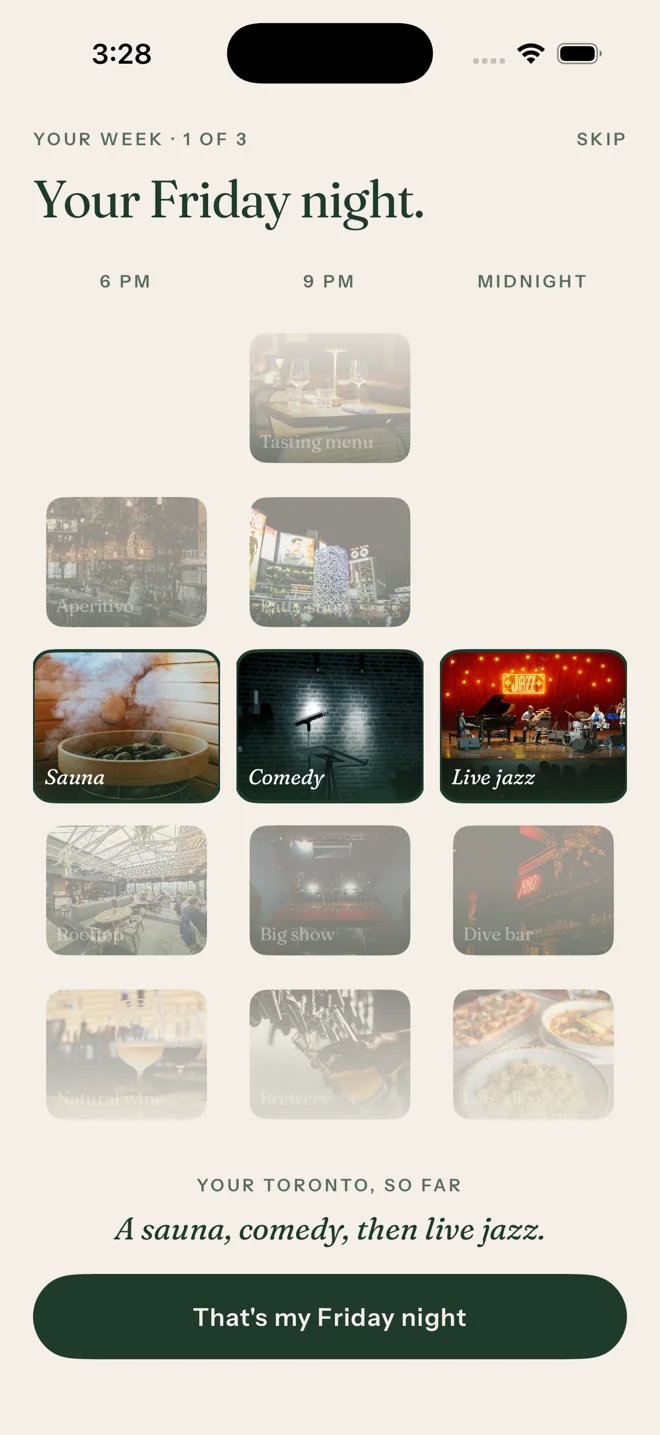
Plan a night6 pm, 9 pm, midnight. The sentence writes itself. 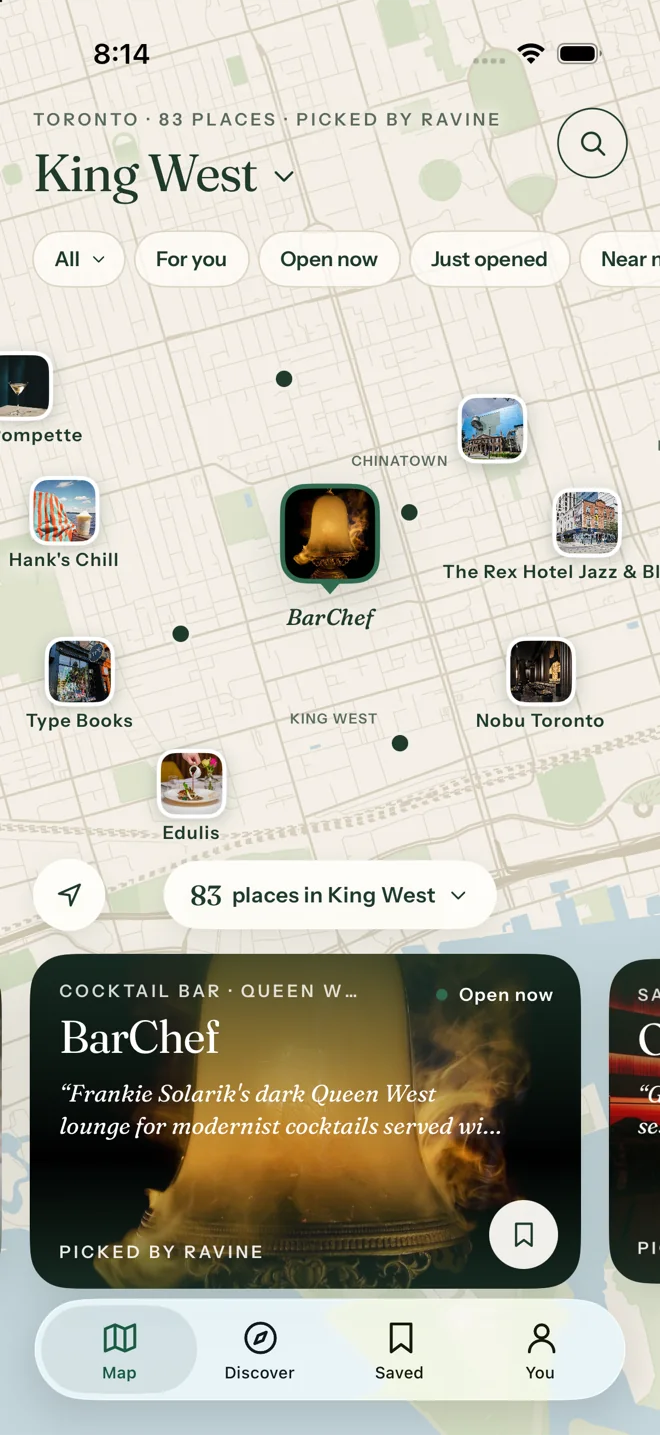
The mapA few places at a time, and the cards follow the map. 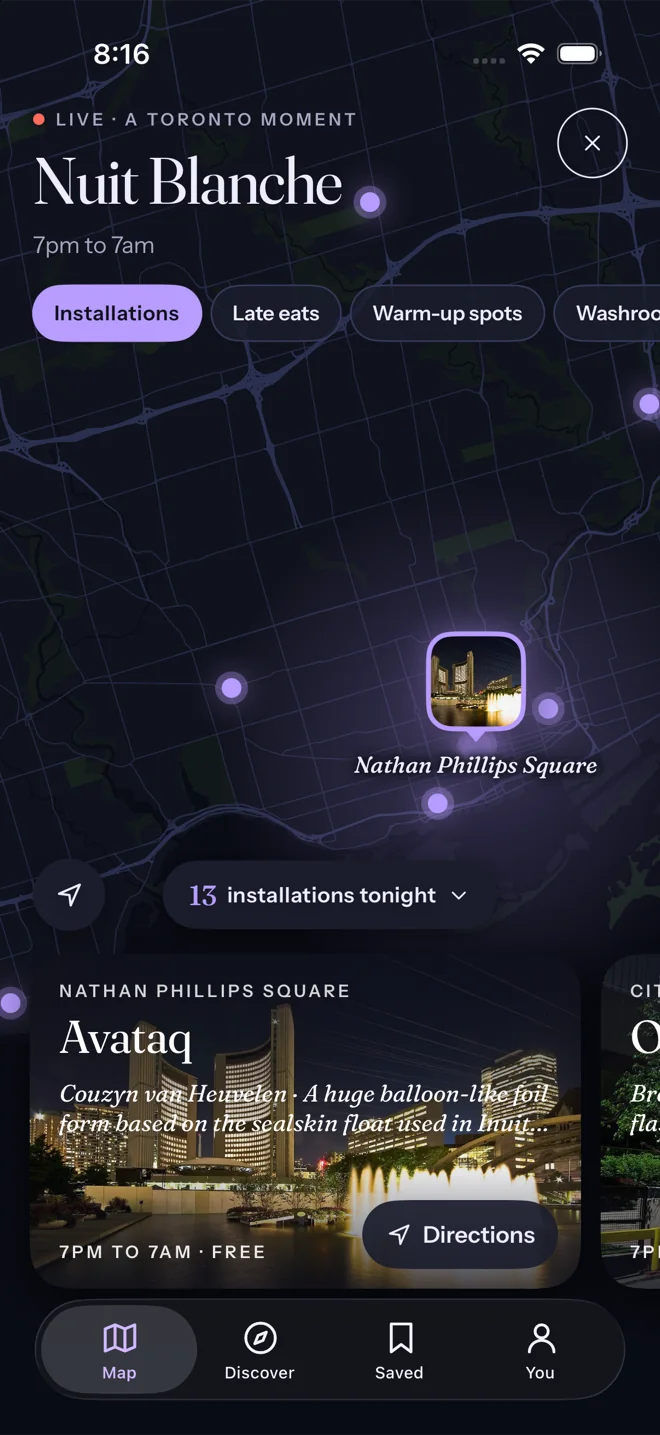
Nuit BlancheA Moment turns the whole app dark for Nuit Blanche, as data.
places, each with hours, an address and a source beside the post
licensed photos, credited, served from a private bucket by version
Toronto Moments that re-skin the app: Nuit Blanche, the Waterfront Marathon
tests against a real Postgres, one of which fails if any isolation policy loosens
the look
Quiet luxury on paper.
Fraunces set light and large, deep ravine green as the ink, hairlines where other apps use fills, the platform's own glass tab bar. Ravine's own dialogs replace the system's. A Moment ships as a set of colour values and a map style, never as new components, so Nuit Blanche is a theme and the Marathon is a layer.
- #F4EFE6
- #1F3A2D
- #2F6B4F
- #C6392E
- #3C7A96
- #B79CFF
- #F2B261
what it runs on
The stack.
- App
- SwiftUI, XcodeGen, MapLibre with OpenFreeMap tiles
- API
- FastAPI, SQLAlchemy async, four workers sized by a load test
- Store
- Postgres with row-level security, slugs for the catalog, UUIDv7 for owned rows
- Accounts
- Guest first, Sign in with Apple to keep your places
- Photos
- A private bucket, presigned for an hour, cached on the phone by version
- Gates
- ruff, mypy, tests on Postgres, hand-written migrations
Coraki
An applied AI studio I co-founded with Cory Crowley.
What we do
A software studio.
Coraki builds AI-native and classic full-stack software for funded startups and enterprises: the first version of a product, the integration that makes an existing one intelligent, or an engineer embedded with a team that needs one.
Selected work
What’s shipped.
Real-time voice
Coraki shipped a real-time voice platform, where the engineering includes working within latency budgets.
Clinical co-pilot
Coraki shipped a clinician co-pilot inside an electronic health record, with multi-tenant authentication and privacy requirements.
Studio apps
memo and Ravine are Coraki’s own. They are where the standards get tried on something with one user before they are promised to someone else’s.
Contact
Work with Coraki.
Projects have a fixed scope and price.
About
Background
One square at a time.
Platform engineering
I build the platforms other engineers depend on: storefront hosting at the edge, the datastore under every background job, the rollout and failover paths that let a system change while it is running. Six years of that at Shopify, across three teams.
Coraki and my own apps
On the side I co-founded Coraki, and I write apps for myself to the standard I would hold someone else's to. memo is on my phone every day. Ravine is the Toronto I would show a friend. Both come with their decisions written down, because a choice with no stated downside is a choice I did not understand.
Why chess?
This site is a chess set because each of those things moves differently, and because looking at a shelf of pieces is a step away from the internet.
Reach me
Your move.
Platform and infrastructure work, applied AI through Coraki, or anything meant to last longer than a quarter.
Writing
First post forthcoming.
Back to contents